

Last Updated: 27 October 2026
Quick Summary
Aim for seven to nine hours of sleep after a night shift, the same amount you'd get after any other shift. Protect a block of sleep long enough to matter rather than relying on a magic number, and decide your sleep window before you leave work.
- Night shift workers need the same seven to nine hours as everyone else, though daytime sleep is often shorter and lighter.
- Get into bed within an hour of finishing, after a light meal and dimmed lights.
- A short nap before a night shift can be 20 to 30 minutes in the late afternoon, or up to 90 minutes.
- Cut off energy drinks at least six hours before your sleep window.
- On your first rest day, sleep your usual post-shift block, then get up and outside into daylight.
Table of Contents
- How Long Should You Sleep After a Night Shift?
- How Many Hours of Sleep Do Night Shift Workers Need?
- How to Sleep During the Day After a Night Shift
- The Best Sleep Schedule for Night Shift Workers
- Should You Nap Before a Night Shift?
- Common Problems and Practical Fixes
- Supporting Your Sleep With Noctiva Reset
- Planning Your First Rest Day After a Run of Nights
- Frequently Asked Questions
How Long Should You Sleep After a Night Shift?
Most people need around seven to nine hours of sleep after a night shift, and the honest answer is that you should aim for the same amount you'd get after any other shift. If you're wondering whether you can catch up on sleep after night shifts, that guide explains how sleep debt works and how to recover on a rota. The trick isn't a magic number. It's protecting a block of sleep long enough to matter.
If you finish at 7am and need to be back for 7pm, that leaves roughly eleven hours. Once you subtract the journey home, something to eat and the wind-down, a seven-hour sleep is realistic. It won't always happen. A doorbell, a delivery, or a child who needs collecting from school will see to that.
This guide covers how long to sleep after a night shift, how to build a daytime routine that works with your rota, and what to do when it all goes sideways.
Sleep after a night shift works best when you treat it as a fixed appointment rather than whatever's left over. The first rule: decide your sleep window before you leave work, not when you get home and collapse.
How Many Hours of Sleep Do Night Shift Workers Need?
Night shift workers need the same seven to nine hours as everyone else. The difference is that daytime sleep is usually shorter and lighter, so many shift workers end up running a sleep debt without realising it.
The NHS guidance on how much sleep you need puts the adult range at seven to nine hours. That figure doesn't change because your shift does. What changes is how easily you get it.
Why the Body Struggles to Bank Sleep in the Day
You can't bank sleep in advance, either. A long lie-in on Sunday won't cover three nights of four hours. Sleep debt builds and has to be paid back in sleep, not caffeine.
How to Sleep During the Day After a Night Shift
To sleep during the day after a night shift, get home, eat something light, and get into a dark, cool room as quickly as you reasonably can. Skip the screen scroll in the kitchen.
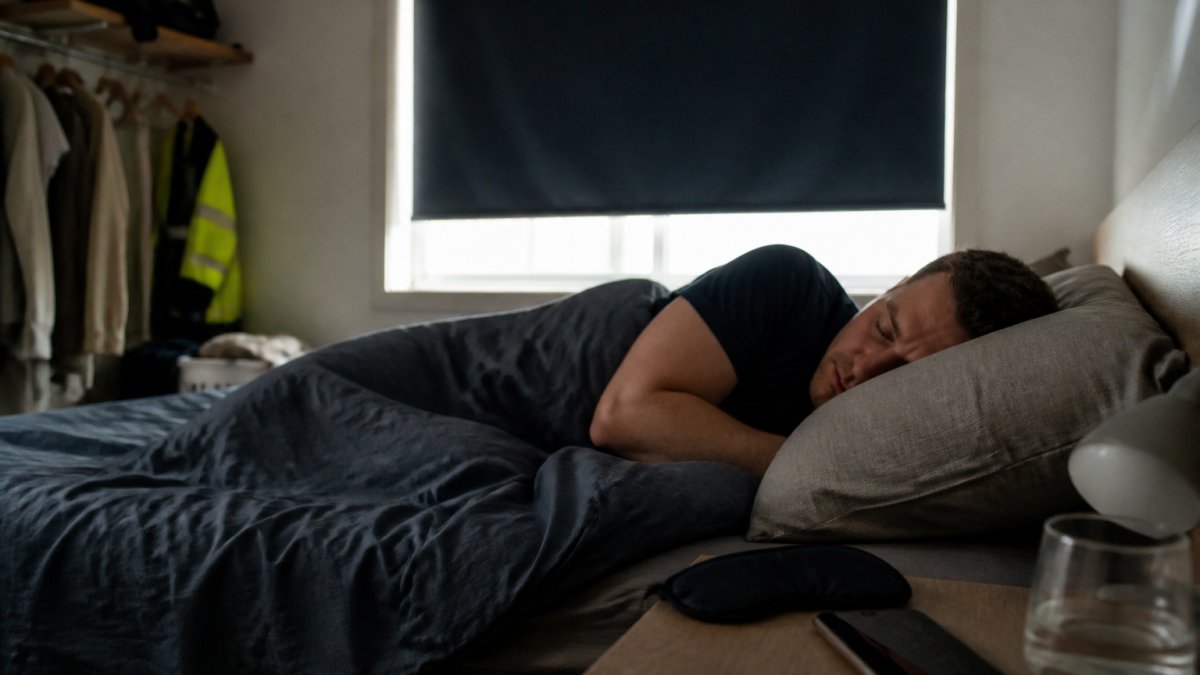
A workable routine looks like this:
- Travel home calmly. Bright sunlight on the drive back is working against you.
- Eat a light meal. Something plain and easy, not a full dinner.
- Dim the lights. Keep the hallway and bathroom low.
- Get into bed within an hour of finishing. The sooner you start, the more sleep you get before the day wakes up.
- Set one alarm. Pick your wake time and stick to it.
Setting Up a Bedroom That Helps You Switch Off
Your bedroom does most of the work here. You need dark, cool, and quiet, in that order.
- Blackout blinds or curtains, or a good eye mask if you rent and can't fit them
- Earplugs for traffic, bin collections and the neighbour's hedge trimmer
- A cool room, with bedding you can throw off
- Phone on silent and face-down, or better, in another room
If you share a home, agree some ground rules. A note on the door saying you're asleep until 3pm saves a lot of doorbell-related misery.
The Best Sleep Schedule for Night Shift Workers
The best sleep schedule for night shift workers is one you can repeat. Pick a sleep window and keep it the same across a run of nights, even on your days off where you can.
Noctiva Reset | Supplement for UK Night Shift Workers →
If you want a step-by-step plan for shifting your body clock between runs, our guide on how to reset circadian rhythm after night shift walks through light, timing and routine in order.
Three Realistic Patterns for Different Rotas
There's no single schedule that suits everyone.
| Pattern | Sleep window | Best for | Watch out for |
|---|---|---|---|
| Split sleep | 4-5 hours after shift, 2-3 hours before | Parents, carers, shared homes | Needs discipline to restart |
| Single block | 7-8 hours straight after shift | Permanent nights, quiet households | Fragile if the day is noisy |
| Anchored | 6 hours, same time daily | Rotating rotas | Takes a week to settle |
If your rota flips between days and nights, it helps to understand how rotating shift work disrupts your sleep patterns before you pick a pattern.
Should You Nap Before a Night Shift?
A short nap before a night shift is one option (Hints and tips for shift-workers). Aim for 20 to 30 minutes in the late afternoon, or up to 90 minutes if you have the time and can wake without grogginess.
Common Problems and Practical Fixes
Here's how to handle some common difficulties.
- You can't drop off when you get home. Try a warm shower, low light and no screens for twenty minutes.
- You wake after three hours and can't get back down. Stay in the dark room. Don't switch on a lamp or check your phone.
- The house is too noisy. Earplugs, a fan for white noise, and a word with the household about the doorbell.
- You feel wrecked by night three. That's normal. Protect your sleep window more fiercely on the middle nights.
- You're relying on energy drinks. Cut them off at least six hours before your sleep window.
Watch out: if you're falling asleep at the wheel on the way home, that's a safety issue, not a scheduling one. Persistent exhaustion that doesn't ease with sleep is worth raising with your GP (the NHS).
Supporting Your Sleep With Noctiva Reset
A supplement can't replace sleep, and it won't fix a rota that gives you five hours in bed. If you're weighing one up, it's worth reading what the science shows about night shift sleep supplements, including melatonin, magnesium and ashwagandha.
Noctiva Reset is a food supplement made for people who work nights, lates and rotating patterns. Each three-capsule serving contains magnesium bisglycinate at 175mg, KSM-66® ashwagandha root extract at 490mg, griffonia seed extract providing 100mg of 5-HTP, and 100mg of L-theanine from green tea leaf. Magnesium contributes to the reduction of tiredness and fatigue and to normal nervous system function. One tub holds 90 capsules, which is 30 days at the stated dose.
You can also view the full Noctiva Reset product details to check the ingredients, directions and warnings for yourself.

Planning Your First Rest Day After a Run of Nights
- Sleep your usual post-shift block on the first morning
- Get up at a normal-ish time and get outside into daylight
- Go to bed at a sensible hour that night, even if you're not shattered
- Keep the next morning's wake time steady
Getting the hours right after a night shift is one thing. Getting them consistently, week after week, on a rota that keeps moving, is the harder part. Noctiva Reset is a UK-made food supplement with magnesium to support normal nervous system function and reduce tiredness and fatigue. Explore Noctiva Reset.
Frequently Asked Questions
How many hours of sleep do you need after a night shift?
The article links to NHS guidance on how much sleep adults need. Daylight, noise and family routines can make daytime sleep difficult.
Should you go straight to bed after a night shift?
The article suggests getting home, having a light snack and dimming the lights. It does not establish a specific wind-down time or say that going to bed straight away works better.
Is it better to sleep for a few hours or stay awake after a night shift?
The article does not establish whether a few hours of sleep or staying awake is better, or give a specific sleep duration for this situation. Persistent inability to sleep is worth raising with your GP.
Should you nap before a night shift?
The article does not establish that a nap improves alertness or specify a suitable nap duration or timing. A nap does not replace a main sleep block.
