

Table of Contents
- Shift Work Sleep Disorder: Why Daytime Sleep Feels Impossible
- Shift Work Sleep Disorder Symptoms You Might Be Dismissing
- How to Sleep After a Night Shift When the World Is Awake
- Building a Night Shift Sleep Schedule That Works With Your Rota
- When to See a GP About Sleep Problems
- Supporting Your Body Through Shift Work Sleep Disorder
- Practical Checklist for Managing Daytime Sleep
- The Real Deal…
- Frequently Asked Questions
Last Updated: October 14, 2026
Shift Work Sleep Disorder: Why Daytime Sleep Feels Impossible
Shift work sleep disorder is a recognised sleep-wake condition that affects people whose working hours run against the body's natural clock. If you finish a night shift, get home at 7am, and lie awake while the rest of the street starts its day, you are not doing anything wrong. Your body is simply confused.
This guide from Noctiva Health looks at why daytime sleep feels so hard, and what you can realistically do about it.
Your internal body clock, sometimes called the circadian rhythm, expects light and darkness at certain times. Night shifts flip that expectation upside down. The result is a mismatch: you are tired when you need to be alert, and wired when you finally get the chance to sleep.
The daytime world does not help. Bin lorries, deliveries, school runs and the neighbour's hedge trimmer all arrive on a schedule built for people who sleep at night.
The good news is that shift work sleep problems can be managed. It takes planning, honesty about your rota, and a few practical habits. We will cover symptoms worth noticing, how to sleep after a night shift, how to build a night shift sleep schedule, and when it is worth speaking to your GP.
Shift Work Sleep Disorder Symptoms You Might Be Dismissing
The most common sign is persistent difficulty sleeping when your rota says you should, paired with heavy sleepiness during your shift. Many people brush this off as "just part of nights". It is worth taking seriously.
Other shift work sleep disorder symptoms include:
- Trouble falling asleep within 30 minutes of going to bed
- Waking up too early and being unable to drift back off
- Feeling unrefreshed even after seven or eight hours in bed
- Struggling to stay alert in the second half of a shift
- Headaches, low mood or irritability that track with your rota
- Relying on caffeine to get through, then needing it to function
The NHS notes that ongoing sleep problems can affect mood, concentration and physical health, so they are not something to simply push through. You can read more in the NHS guidance on insomnia and sleep problems.
A key thing to remember: one bad week is not a disorder. A pattern that lasts for weeks or months, and lines up with your shift pattern, is worth investigating.
How to Sleep After a Night Shift When the World Is Awake
The best approach after a night shift is to protect a block of sleep, usually in the morning, and treat it as non-negotiable. You will not sleep perfectly every time. But you can stack the odds in your favour.
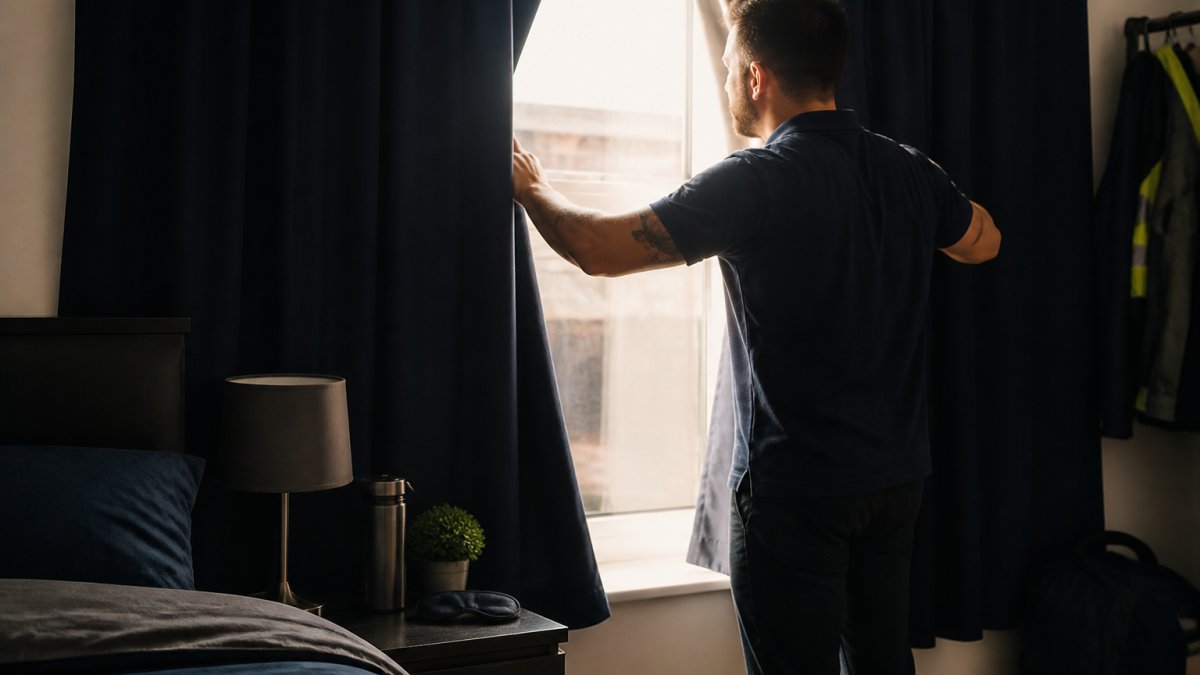
The Wind-Down Hour: What to Do Before Your Head Hits the Pillow
Give yourself a wind-down hour before bed. It sounds fussy. It works.
- Keep the lights low as soon as you get in
- Skip the big meal; a light snack is easier on your system
- Avoid alcohol as a sleep aid, it fragments sleep later
- Put your phone down and resist the scroll
- Keep the room cool, dark and quiet
If you use caffeine through the night, stop it a few hours before your shift ends where you can. It lingers longer than most people realise.
Managing the Drive Home and the Doorbell Problem
Driving home tired is a genuine safety issue, not a minor inconvenience. If you feel yourself drifting, pull over somewhere safe and rest. Do not push through. The HSE guidance on managing fatigue at work is clear that fatigue is a workplace hazard, not just a personal one.
Then there is the doorbell. And the delivery driver. And the neighbour who has chosen today to discover power tools.
A few small fixes help:
- A note on the door asking for no knocks
- A phone on silent, or a separate number for family
- A white noise app or earplugs
- Telling your household what "asleep" actually means
Building a Night Shift Sleep Schedule That Works With Your Rota
A workable night shift sleep schedule is one you can repeat, not one that looks perfect on paper. Consistency matters more than perfection.
The aim is to sleep at roughly the same time each day, even on your days off. Big swings between "night mode" and "day mode" make the confusion worse.
A Sample Rotating Rota Timetable
Here is a hypothetical example for someone on a rotating pattern. Adjust the times to fit your own rota.
Shift |
Finish |
Wind-down |
Sleep block |
Wake |
|---|---|---|---|---|
Night 1 |
07:00 |
07:15-08:00 |
08:00-14:30 |
14:30 |
Night 2 |
07:00 |
07:15-08:00 |
08:00-14:30 |
14:30 |
Night 3 |
07:00 |
07:15-08:00 |
08:00-14:30 |
14:30 |
Rest day |
- |
- |
01:00-08:00 |
08:00 |
The point is not the exact hours. It is that your sleep block stays roughly the same while you are on nights, then shifts gradually rather than all at once.
When to See a GP About Sleep Problems
Speak to your GP if sleep problems last more than a few weeks, affect your safety, or leave you struggling to function. You do not need to wait until things are unbearable.
Book an appointment if you notice:
- Sleep problems lasting a month or more
- Falling asleep during the day without meaning to
- Low mood, anxiety or worry that will not shift
- Snoring, gasping or pauses in breathing at night
- Symptoms that affect your driving or your work safety
Your GP can check for other causes, such as sleep apnoea or thyroid issues, and discuss options. Bring your rota with you. It helps to show the pattern rather than describe it from memory.
Supporting Your Body Through Shift Work Sleep Disorder
You cannot fix a biological mismatch with willpower alone. What you can do is support your body while it adjusts, and be honest about what helps and what does not.
General foundations still matter: a varied diet, regular movement, and daylight exposure when you can get it.
Some people also look at supplements as part of a wider routine. Noctiva Reset is a food supplement made for adult shift workers. Its magnesium contributes to the reduction of tiredness and fatigue, and supports normal nervous system function. It also contains KSM-66® ashwagandha, Griffonia simplicifolia seed extract and L-theanine.

To be clear: a supplement is not a substitute for sleep, a healthy lifestyle or medical care. It sits alongside the practical steps above, not instead of them. You can read more about Noctiva Reset if you want the full ingredient list.
Practical Checklist for Managing Daytime Sleep
Use this as a quick reference you can stick on the fridge or save on your phone.
- Blackout curtains or blinds fitted in the bedroom
- Sleep mask and earplugs within reach
- Phone on silent, doorbell covered or switched off
- Household told your sleep hours
- Caffeine cut off a few hours before shift end
- Wind-down hour with low light and no screens
- Same sleep block repeated across your night shifts
- Daylight exposure on waking where possible
- GP appointment booked if problems persist
The Real Deal…
Shift work sleep disorder is not a character flaw, and it is not something you simply have to endure. It is a real mismatch between your rota and your body clock, and it deserves proper attention.
Start with the basics: protect your sleep block, manage the wind-down hour, and speak to your GP if things do not improve. If you want extra support alongside those habits, Noctiva Reset is made for adult shift workers, with full dose declaration, UK manufacturing, and magnesium that contributes to the reduction of tiredness and fatigue.
Order now and see how it fits into your routine.
Frequently Asked Questions
What is shift work sleep disorder?
Shift work sleep disorder is a circadian rhythm sleep disorder that affects people whose working hours run against the body's natural sleep-wake cycle. The main signs are difficulty sleeping when you need to, excessive sleepiness during your shift, and a persistent feeling of not being rested. It is more than just feeling tired after a run of nights; the pattern continues and starts to affect your mood, concentration and safety. If your rota has changed your sleep for weeks and it is not improving, it is worth speaking to your GP.
How many hours of sleep should shift workers aim for?
Most adults need seven to nine hours of sleep in each 24-hour period, though this varies between people. Shift workers often struggle to get that in one block because daytime sleep is shorter and lighter than night-time sleep. A common approach is to aim for a main sleep of around six to eight hours after your last night shift, plus a short nap of 20 to 30 minutes before your next shift if you can fit one in. Consistency matters more than perfection.
Should you nap before or during a night shift?
Both can help. A nap of around 20 to 30 minutes before your shift can take the edge off sleepiness without leaving you groggy. If your workplace allows it, a short nap during a break, ideally before 3am, can also help you get through the second half of the shift. Keep naps short to avoid sleep inertia, and give yourself a few minutes to wake up properly before driving or operating machinery.
Is it safe to drive home if you feel very sleepy after a night shift?
No. Driving while sleepy is dangerous and is a recognised risk for shift workers. If you feel your eyelids drooping, find yourself drifting or struggling to remember the last few miles, pull over somewhere safe and rest. A short nap of 15 to 20 minutes, or a caffeinated drink followed by a brief rest, can help temporarily, but they are not a substitute for proper sleep. Plan ahead: share lifts where possible, use public transport, or arrange to rest before setting off.
Can shift work sleep disorder be treated?
Yes, it can usually be managed. The first step is often adjusting your sleep schedule, light exposure and wind-down routine to support your body clock. Your GP may discuss other options if these measures are not enough, and can check for other conditions that affect sleep, such as sleep apnoea or thyroid problems. If you are taking medication or have an existing health condition, always speak to your GP or pharmacist before starting any supplement, including Noctiva Reset, as some ingredients may interact with prescribed medicines.